
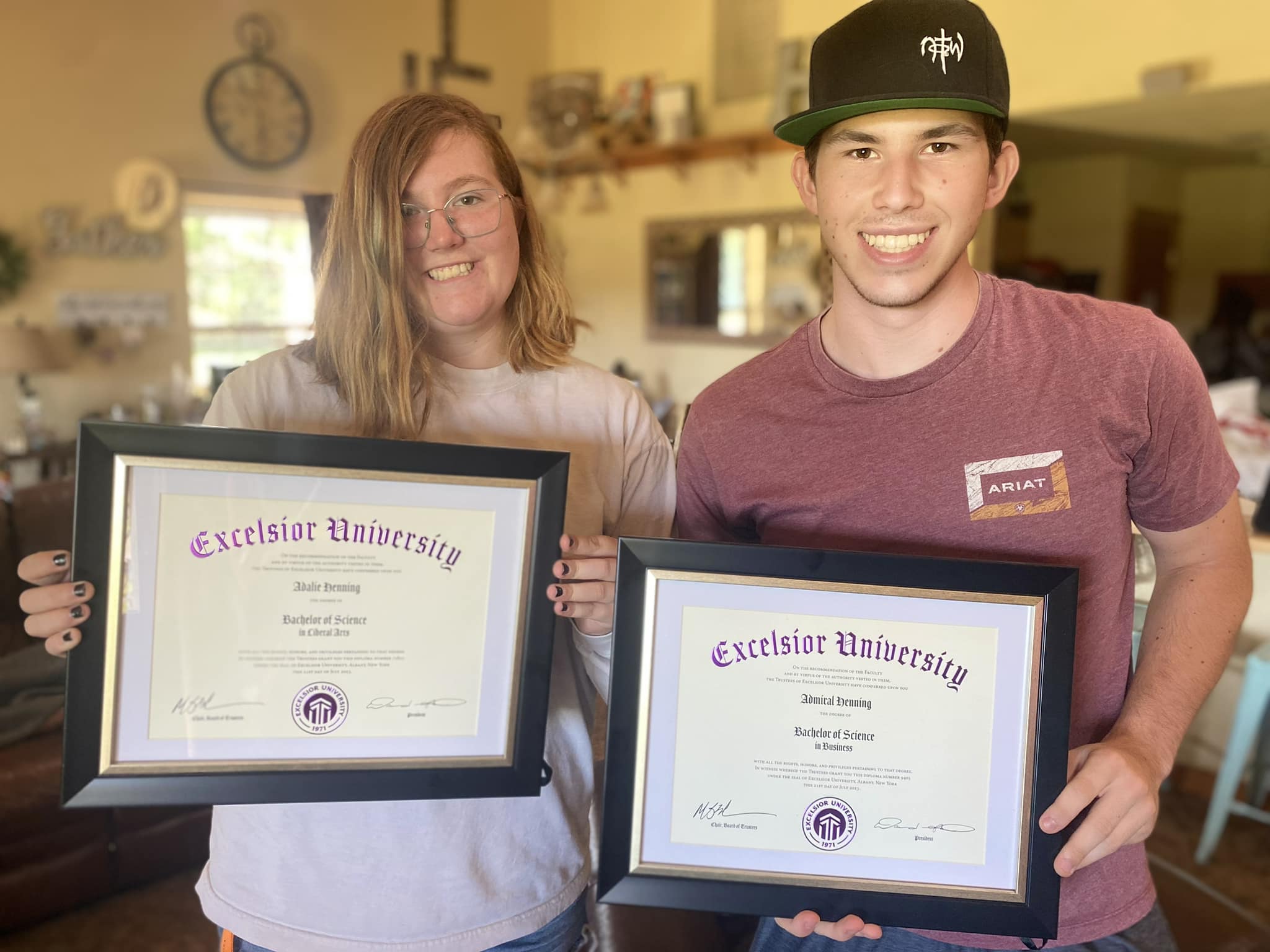
Cherish, a HS4CC mom from Kansas, shares her story of how she homeschooled two of her teens through high school and college graduation at home, both earning bachelor’s degrees without debt.
We often talk about how some families max out alternative ACE credits (Sophia, Studycom, CLEP, AP, etc.) at partner universities for the ultimate low-cost degree. Cherish’s two teens earned their degrees from Excelsior University over the course of 2 years while homeschooling. She’s allowed me to share her story with you here and agreed to answer questions, so feel free to comment below! Enjoy!
“I don’t think this way is for everyone, but if you are reading this, then you clearly feel that it may be for your family, and I am happy to share. I own a design business and work from home while homeschooling my 4 kids, now ages 9, 11, 17, 18. I was home and motivated to help them achieve this big goal.
WHY?
My husband and I both have bachelor’s degrees, which are required to work in the fields where we work. However, we graduated with large student debt and sure wish we hadn’t gone into marriage having to focus on paying that back. Thankfully, we had jobs in the fields we studied, but we were aware that plenty of people join the system and paid the price for something they never wanted because they felt they had to go. We also agreed that, in our experiences, on-the-job training provided us with much more knowledge than our degrees. So, we set out to help them get the paper quickly, and homeschooling allowed us this opportunity. We have always homeschooled, and we have always schooled year-round, so when they finished one grade, we just moved to the next. This meant that the kids were starting high school work a little early. I have said that if I am going to be teaching Algebra, it might as well be College Algebra, and so we started the journey of dual enrollment when they were ready for high school work.
GOALS
1. Be as close to free as possible.
2. Do all the work online.
3. Get credits as quickly as possible.
RESOURCES
I began hours upon hours of research, trying to determine how they could do this. What I learned is that there are many different paths, but as I started putting pencil to paper and working out options, one very clear path was made. For us, Excelsior University was the easiest and cheapest and offered degrees the teens could work with, so we dedicated ourselves to that path and didn’t waiver.
I joined my HS4CC in Kansas Facebook group and learned so much more there too!! I also learned more about all the credit sources available: Sophia, Studycom, Coopersmith, LawShelf, Saylor, Straightline, CLEP, DSST, community college, and 4-year university dual enrollment options. We live in Kansas and get free dual enrollment.
Under the Excel in Career and Technical Education Initiative, Kansas high school juniors and seniors can qualify for free college tuition for approved CTE technical courses offered at Kansas technical schools and community colleges.
OUR PLAN
Because it was the summer of 2020 when we started, Sophia was offering FREE classes! My teens jumped on this and took EVERYTHING they could. Sophia is a self-paced, open-book college credit program. They took Introduction to Sociology, Introduction to Psychology, Introduction to Ethics, Composition I & II, College Algebra, Environmental Science, US History I & II, etc. If it was a “general education,” they took it, knowing that Excelsior University was a Sophia partner, and all the classes would transfer there for sure. (This isn’t a guarantee for every school, but that was the peace
of mind that came with choosing Excelsior). Sophia, for us, was by far the
cheapest credit option, and they were able to complete their first two years of school for next to nothing.
General education typically includes most English, Literature, History, Political Science, Behavioral Science, Anthropology, Ethics, Philosophy, Economics, Art Appreciation, Humanities, Natural Science, Physical Science, and World Languages courses.
I will add here that our original plan was to get the Modern States vouchers for free CLEP tests and test-out of all the general education classes that way. However, COVID shut down the testing sites, and online CLEP testing wasn’t a thing yet.
After they had taken all the Sophia classes that would transfer for their degree requirements, we looked at each community college that offered the free Kansas CTE Initiative classes. Many of the CTE classes actually counted towards a business degree, so our son took those along with all his electives. He just looked at the list, and started picking electives based on what he wanted to take that was free. Same for our daughter, and she was happy that some agricultural classes were on the list and she took some equine classes too. These classes took all semester, so they didn’t qualify as the “fastest option.” Still, free was good, and they could enroll in as many as they wanted, so they loaded up in the fall and spring semesters, and at the end of the school year in 2021, they had accumulated almost 60 credits. (Bachelor’s degrees require 120 credits). They used these classes to meet their high school requirements in English, history, math, science, and electives. They both also played sports music, had jobs, and were involved in 4-H, so other credits were met that way also.
SUPERVISION
These college courses required that I help them navigate the college learning platforms. I also wrote out a weekly work schedule that helped them time their week to complete tasks on time. I logged into their accounts with them, checked that they turned in their work, and I checked that they were responding to all class emails. I was still their teacher. I had them turn in papers to me first for comments, and they came to me with any lesson or instructions they didn’t understand so I could
teach it to them.
I did all the “administration” tasks for them. I ordered all their books, registered, checked transfer credits, and checked graduation requirements. This took a lot of my time the first year, but less the second year, and hardly any during the third year. I still held them accountable and asked them if they were keeping up, but by then I didn’t have to show them how to navigate or log on, and I didn’t have to check on them anymore.
UPPER LEVEL
They were now needing degree-specific classes, and most of them were upper-level. These are so much harder to find online. I kept debating with them taking the classes from our local university, but I didn’t want to spend the money or have them sit in class with college juniors and seniors at their ages (16/17) so they took a bulk of their upper-level classes from Study.com. At Study, they watch videos, read chapters, and take quizzes. Then, there are assignments to turn in and a final exam. You pay monthly and work at your own pace. Using Study for all the classes they could from their list was great, and it left only a handful of courses that had to be taken somewhere else before enrolling. My teens took the rest of their upper-level courses from Coopersmith and Law Shelf.
ENROLLING AT EXCELSIOR UNIVERSITY
Once they had finished earning all the possible credits, from every source that they could, to meet their degree requirements, it was time to enroll in Excelsior. You must first graduate your student, then you can transfer 113 credits to Excelsior, and only
take the last 7 required credits directly from them.
- Information Literacy is a 1 credit self-paced course that teaches you how to navigate their online school, and it can be taken anytime in the first semester.
- Cornerstone is a 3 credit-hour class. If you wait to take this until you have transferred in all your hours, you are considered an upperclassman and the class is a 300-level class and counts as one of your upper-level class requirements (bonus!), so I would advise that.
- Capstone is a 3 credit-hour class. It is a grueling 8-week course that culminates in a 15-18 page paper. For our son, it meant that he participated in an online business simulation with his teammates all over the world, and then wrote a synopsis of their business success, pitfalls, and what he learned, applying everything he has learned in all his business classes. For our daughter, it meant that she researched for weeks, and worked toward writing a paper on a humanitarian issue that affected the entire planet. For our son, It was a lot of work, but it was the only class in high schedule, so since he was used to doing much more at a time, he managed well.
They finished their Capstones together! They could have walked in the commencement, but we declined the invitation to participate. They were able to do all of this from the summer of 2020 to the summer of 2023.
TIPS
My advice after going through this with my first two teens
- Know your teens well. Know their strengths, know their commitment level, know their talents and interests well enough to be able to guide them long before they know themselves and decide what direction they want to go.
- Know your plan will change over the time they are taking the classes.
- If they won’t attend an ACE partner college, think long and hard before going this route or taking ACE credits. It is always safer to take traditional classes from local community colleges or online universities.
- If your teen wants to get a degree in something that requires 4 years of consecutive classes, like Studio 1 in year one, Studio 2 in year two, Studio 3 in year three, and Studio 4 in year four, then don’t go this route. Even if they take all the credits they can ahead of time, once they transfer them to their brick-and-mortar school of choice, they will still be at that school for 4 years and most likely
will be required to take 12 hours a semester to live on campus or participate in extracurriculars. - If your teen enjoys learning, or they are going into a field that requires deep knowledge of the subjects in the field, this likely isn’t a good path unless time is not of the essence.
- If you are not willing to remain their teacher, and invest your time and energy into planning, I would not advise this path. I do not think that most teens would be able to navigate this on their own. Our state has requirements for homeschooling that requires me to remain involved as their teacher, and
that helped motivate me to dual enroll in order to maximize the rewards of my my time and theirs. - While their degrees were much cheaper than traditional college, it still cost us more than homeschooling would have us. Their degree costs varied, but it cost us around $6,000 for each of their bachelor’s degrees done this way.
To learn more about the kinds of credits Cherish used in her family’s homeschool, check out our 30 Ways to Earn College Credit page and subscribe below.

