
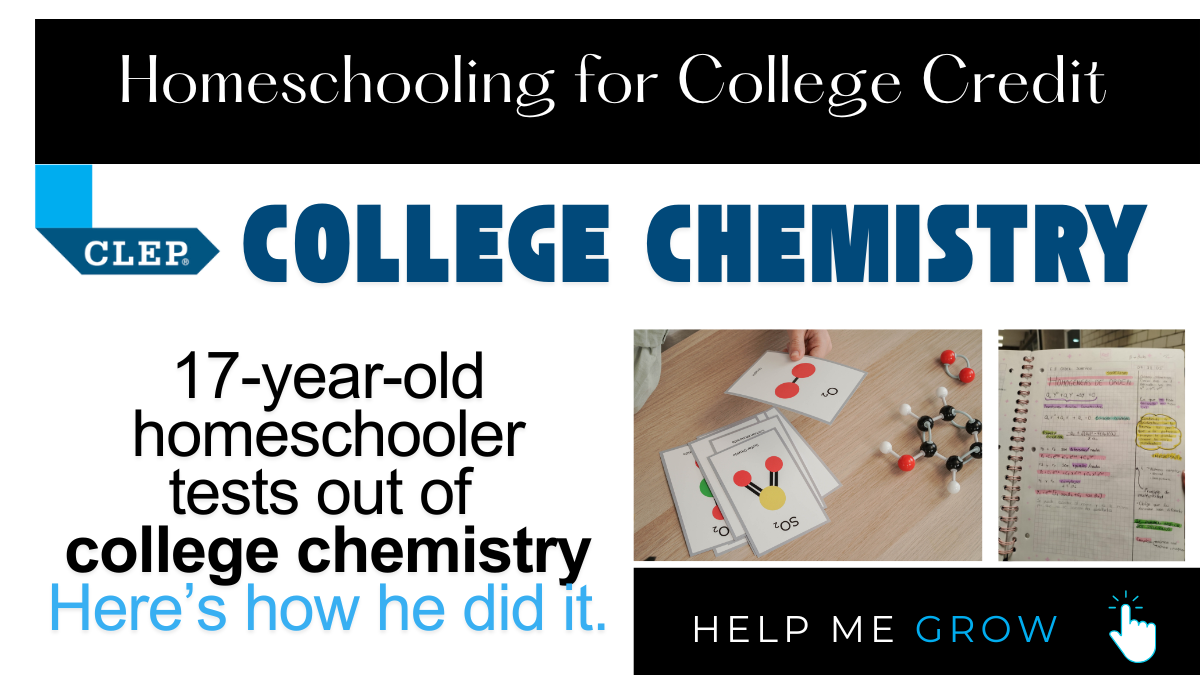
This exam is no joke. It has the lowest pass rate of any CLEP exam and is an extreme outlier. Most CLEP exam pass rates are 50-90%, but Chemistry is only around 25%, so when Homeschooling for College Credit mom Amy sent me an email that her son Daniel passed the CLEP College Chemistry exam and successfully transferred it to his university, I had to get the details of what they did. Here is exactly what they did.
Daniel is homeschooled in Colorado and already had 29 CLEP credits when he set out to study for Chemistry. He is a future Computer Science major, which requires completion of General Chemistry I with Lab. His university accepts an AP Chemistry exam score of 4 or a CLEP Chemistry exam score of 54 to fulfill this requirement.
The CLEP Chemistry Exam measures knowledge equivalent to a one-year college general chemistry course. Students can expect about 75 multiple-choice questions to be completed in 90 minutes, and most colleges set a passing score around 50, though in this case Daniel needed a 54.
Daniel’s Story
Daniel has always loved science. He competed in the Science Olympiad in a chemistry-focused event and advanced to nationals. As a younger student, he memorized the elements using songs and flashcards, and Chemistry had always been one of his favorite subjects.
Because of this, his family expected the CLEP Chemistry exam to be manageable. That assumption changed quickly.
“College-level chemistry proved to be a very different experience,” his mom, Amy, explained.
Daniel began studying in the fall using the same approach that had worked for his other CLEP exams. He completed the Modern States course*, used REA study guides and practice tests, and reviewed material with Quizlet. This strategy had helped him succeed before, but Chemistry was different.
He quickly realized he was missing key foundational concepts, and the material did not come together the way it had in other subjects. Modern States became a hurdle instead of a support.
“It took him four attempts to pass the Modern States Chemistry test,” Amy shared.
Unlike a traditional classroom, there was no teacher readily available to answer questions. Even with strong reading skills and experience taking tests, Daniel found himself struggling to move forward.
Amy recognized that they needed to change direction. Science was not her strength, and she felt limited in how much she could help. She reached out to others, including a highly experienced homeschool science teacher. Even with her background, the material proved too advanced to tutor effectively.
Amy also asked her husband for help, but his experience was in physics, not college-level chemistry. For the first time in Daniel’s journey, they truly felt stuck.
Instead of stopping, Amy began looking for additional resources. She borrowed an AP Chemistry textbook from the library and added Crash Course Chemistry videos to his study routine. These helped, but the biggest breakthrough came when they scheduled a tutoring session with a local college professor.
The session lasted about two hours and focused on the concepts Daniel found most difficult. It also uncovered something unexpected.
“She found several errors in the REA Chemistry book, including some in questions Daniel had missed,” Amy explained.
The professor even pulled out her own textbooks to clarify the material. With better explanations and targeted support, Daniel began to understand where he had been going wrong.
“He started to grasp the material more confidently,” Amy said.
Progress did not happen overnight. Amy encouraged Daniel to keep working consistently, even when it was frustrating.
“I encouraged him to work on it at least once or twice a week,” she said.
There were moments when he was not excited about studying Chemistry, and there were times when the material still felt difficult. But he kept going.
After months of effort, he sat for the exam.
“He passed the CLEP Chemistry exam with exactly the score he needed, not one point above.”
On one of the hardest CLEP exams available, that kind of result reflects persistence more than anything else.
Daniel plans to attend the University of Colorado as a Computer Science major. At his university, a score of 54 on the CLEP Chemistry exam earns credit for General Chemistry I with Lab.
That single exam translates into real savings. For an in-state student, the value is about $2,500. For an out-of-state student, the savings would be approximately $4,700. One test replaces an entire college course, reducing both time and cost.
Daniel is currently taking ASU Calculus for Engineers, which reflects his strong mathematical background and his path toward a degree that requires Calculus III. This is his first college-level math course, and it has been challenging.
“We are hopeful he will pass and earn three additional credits, but even if not, we still see great value in the experience,” Amy shared.
That perspective matters. The experience itself is preparing him for the level of work required in future calculus courses.
Daniel’s story is a reminder that not all college credit is created equal. Some exams are straightforward, while others require a deeper level of preparation and persistence. Chemistry is one of the hardest, and success often requires families to adjust their approach along the way.
It also highlights something more important. This process is not just about earning credit. It is about building readiness, confidence, and momentum.
If a student earns even one college credit in high school, they are ahead. Daniel has earned many, but this one may have been the most meaningful because of what it required him to overcome.
Getting into college is easy. Getting out is hard.
Every credit earned now brings the goalpost closer.
HS4CC Recommendation
There are some exams that build on prior knowledge rather than new learning, but Chemistry requires both. Students considering this exam should have a background that allows them to learn the content needed for this exam.
Core Science Prerequisites
High School Chemistry (full course, not survey level)
This is essential. The exam expects understanding of atomic structure, bonding, stoichiometry, equilibrium, kinetics, thermodynamics, and lab-based reasoning. Without a full course, students will feel gaps immediately, especially in problem-solving and conceptual application.
Supporting Math Prerequisites
Algebra I
Students must be comfortable solving equations, working with variables, and manipulating formulas. This is used constantly in stoichiometry, gas laws, and equilibrium calculations.
Algebra II (strongly recommended)
Many CLEP Chemistry problems require multi-step reasoning, scientific notation, logarithms (for pH), and more advanced algebraic thinking. Students without Algebra II often struggle with the math portion of the exam.
Highly Recommended but Optional (For Stronger Students)
Physics (or concurrent study)
While not required, physics strengthens mathematical reasoning and conceptual thinking, especially in areas like energy, kinetics, and gas behavior.
Lab Experience (formal or informal)
The exam includes questions about experimental chemistry, including interpreting results, understanding equipment, and applying lab concepts. Students without any lab exposure are at a disadvantage
*Modern States is a nonprofit organization that offers free online prep courses. Upon successful completion of the prep course, they give you a voucher that pays for your CLEP exam in full. Everyone attempting a CLEP exam is encouraged to complete the corresponding Modern States course for added review and to benefit from the full exam costs. Modern states will issue a second voucher if you fail your first attempt. Modern States is a game-changer for families using CLEP.

