
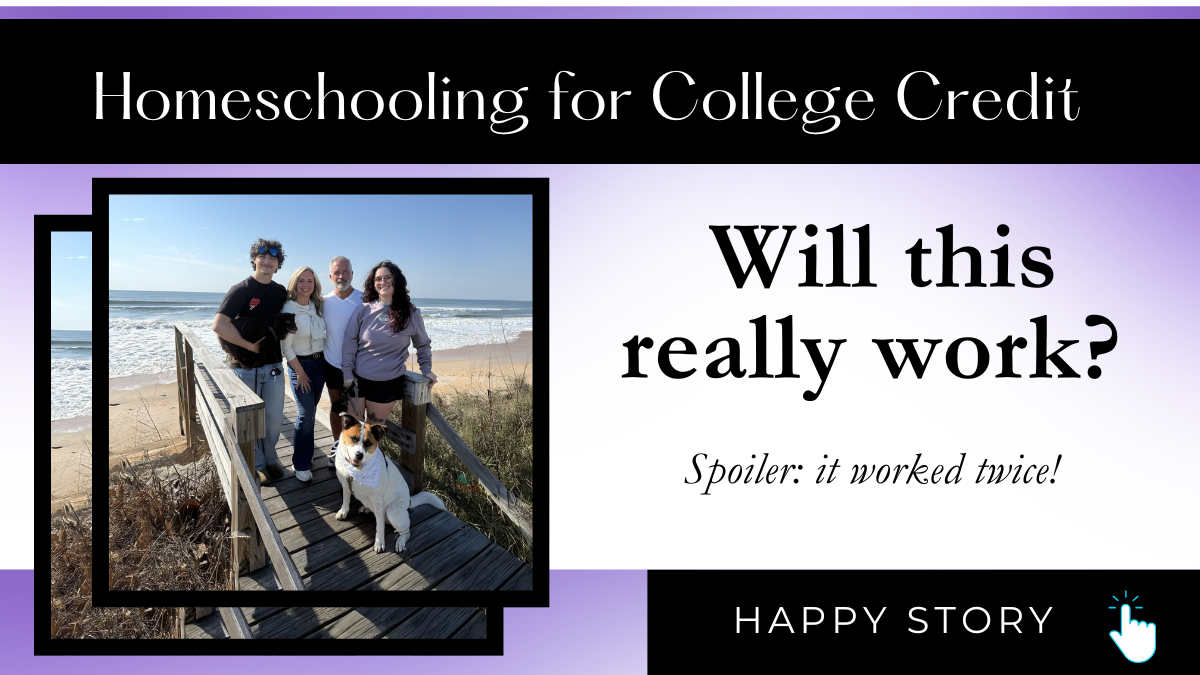
Thank you, Stacy M., for sharing her daughter’s Happy Story with us below. Stacy has been a Homeschooling for College Credit parent for many years, the last few using Arizona State University courses alongside others in our Facebook group. Stacy wondered if this would work, if homeschooling would limit her daughter’s options, and if well-meaning relatives could be right.
Written by Stacy Motherwell,
For every parent in this group who’s ever wondered, “Will this actually work?”
My daughter was homeschooled K–12 and used Arizona State University’s Universal Learner courses to earn college credit in high school. Here’s where that path took her:
- Full tuition institutional scholarship to an R1 research university for undergrad
- Worked in 3 different research labs, including running a pilot study using fMRI & as an RA in a NIMH Clinical Trial
- Graduated summa cum laude, honors college, Blount Scholar
- Used a single strategic gap year to earn certifications and work in her research field
- Just accepted into a fully funded PhD program in Experimental Psychology at an R1 research university
Full tuition. Stipend. They are paying her to study how people with invisible disabilities experience stigma in peer relationships.
I’m not sharing this to brag. I’m sharing this because I remember being the mom, wondering if homeschooling would limit her options. I remember the doubt, the second-guessing, and the well-meaning relatives who questioned our choices.
Dual enrollment via ASU didn’t just prepare her, it gave her breathing room. Enough room to change her major freshman year and still graduate with top honors while conducting rigorous research. And homeschooling? That’s what built the curiosity and self-discipline that made her the kind of scholar a doctoral program wants to invest in.
If you’re early in this journey and wondering whether it leads somewhere real, it does. Your kids have every door open to them. Don’t let anyone tell you otherwise. 
Several of you sent Stacy questions in our Facebook group, these are the answers she gave and her wonderful advice to other parents.
(regarding her older son)
“My son is still at UA, class of 2027! My daughter’s undergrad mentor reached out today and asked her to come speak in one of his 400-level classes about a project she worked on with him. I know she is excited to go back and visit! She is headed to Ole Miss for the PhD – we will be a house divided in the SEC!”
(regarding finding one’s passion)
“If it makes you feel any better, my daughter did not really find the passion that led her here until junior year of college! Lots of time to explore with some general education credits under her belt from ASU!”
(regarding her undergraduate major)
“She declared psychology as her major her sophomore year. Many R1 Universities offer research opportunities to undergrad students. She worked in two different labs where she was paid. The third was for college credit. She dug around and found both paying roles on the University student career center website. She worked year-round in the labs. She stayed for two summers and worked in two labs (one paid, one unpaid/volunteer) and worked at Aramark as a marketing intern for two summers to supplement her income.”
(regarding BOTH of her students receiving full tuition scholarships)
“Beyond proud to report that the last of our two homeschoolers was notified over the weekend that he earned a full tuition scholarship for 4 years of undergraduate college education…This, however, is posted with great humility as my two students could not have accomplished the feat of earning full tuition, merit-based scholarships to multiple schools without help. They both accomplished this achievement without standardized test scores, ***but with 48 dual enrollment credits from **ASU.**
I could not have guided them towards this achievement without the support and help of this group and Jennifer Cook-DeRosa. Thank you to this group, from the very bottom of my heart and to the Universities who recognize that homeschoolers are great additions to their student body – so much so that they award them full tuition.”
“Looking back, the best advice I can give is to begin teaching your student to research the mission of colleges and universities that they might be interested in in attending. Start developing their personal essay writing skills as early as freshman year and keep a file full of stories that they’ve written that speak to who they are. Those stories will help them understand where they will fit best within a college community.
My two students probably submitted close to a combined 500 short answers and essays over the course of the application processes that they participated in. However, most of the content for those responses was written over the course of the prior 4 years. Most were short essays that could be written very quickly based on Common App questions and other college application questions that integrated the mission of the schools that they were interested in pursuing relative to their life experiences. I spent a lot of time referring them back to Common App and other admissions essay questions and pointing out to them that an experience that they had or a topic that they expressed interest in mapped directly to one of the questions on the Common App. They kept a journal and would write draft responses and keep notes in the journal if they didn’t have time to draft full sentences.”
Learn more about how to use Arizona State University courses in your HS4CC dual enrollment program.

