
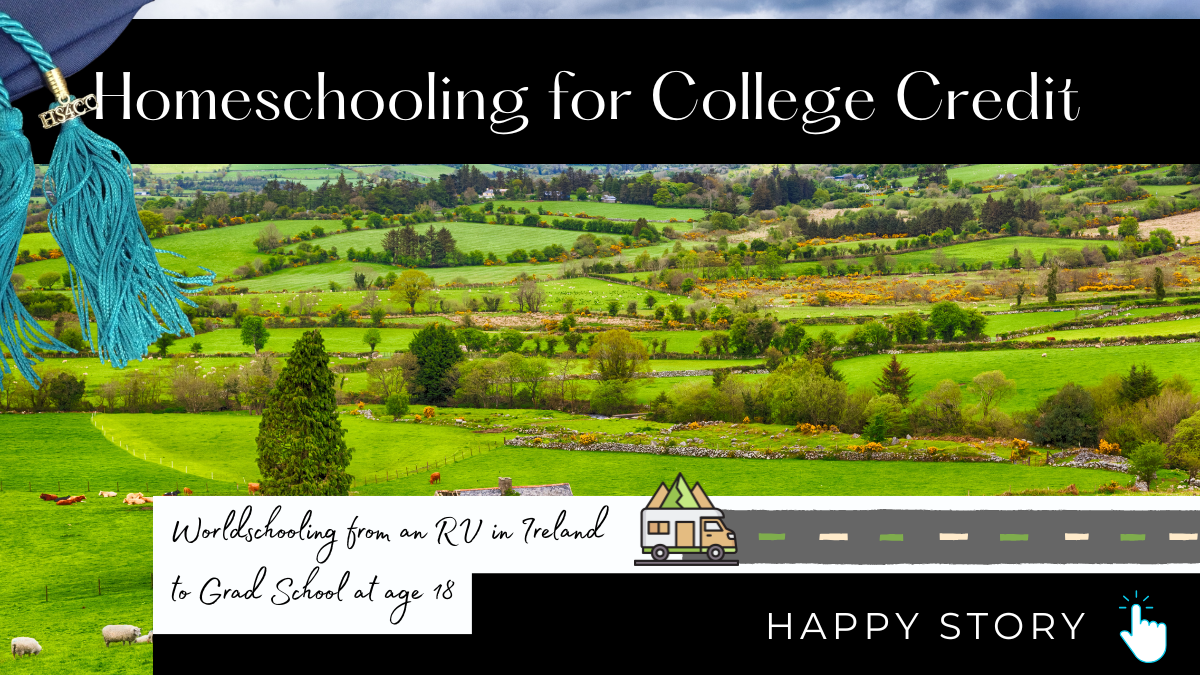
Special thank you to Alina, a Homeschooling for College Credit parent in New Jersey, for sharing her daughter’s incredible story. Alina pulled her daughter from school after noticing an academic dip. After spending the next several months filling middle school gaps, her daughter’s love of learning took off.
Story provided by Alina, Homeschooling for College Credit in New Jersey
While in pre-K, Rebeccah had seen her older sister homeschool during the early grades. She remembered school days at the park, where play alternated with throwing down a blanket and doing worksheets. In the eight-year break between that time and Rebeccah’s 9th grade year, we often looked through the blog I had kept and reminisced about those “good times.” During that time, Rebeccah was an average student who did not grasp concepts easily, but she was always willing to practice her skills if she had resources available.
In middle school, which overlapped with the COVID-19 pandemic, Rebeccah developed some gaps in her academics. These were not obvious in her grades, which were still As, but they were visible to me. When she started 9th grade, she found herself placed in all-honors classes based on her middle school teachers’ recommendations. She started struggling, and her grades slipped to Bs. In a moment of discouragement, with material being introduced faster than she could assimilate it and a shaky foundation she could barely remember, she said to me, “I wish we could go back to homeschooling.”
It was already early March of 9th grade, and I was not only working full-time, but also taking extra evening and urgent care shifts as an essential worker. My husband could not help either. While we did not make the decision lightly, we reached it quickly. She was pulled out of school the following week, and the rest is history.
We spent the next couple of months backtracking through middle school at a fast clip, but with two huge benefits. First, Rebeccah regained her love of learning, despite doing most of this work unsupervised. Second, Rebeccah’s sister, who is four years younger, absorbed it all too. Rebeccah’s confidence soared. Unbelievably, by summer, we were ready for college credit.
I had used those months to read Jennifer Cook-DeRosa’s book, browse the Homeschooling for College Credit Facebook groups, and read all I could about earning college credit in high school. We settled on College Composition I for Rebeccah’s first dual enrollment course, which she took online through Missouri Southern State University. She loved the course, completed it with an A, and came away yearning for more college credit.
She immediately took the one-credit Business Technology Fundamentals course from Arizona State University and wanted more. That fall, she took three more dual enrollment courses: Sociology, Library Research, and Quantitative Reasoning. She also passed three College-Level Examination Program (CLEP) exams: College Composition, American Government, and Spanish.
I won’t bore you with every course she took, but her progress moved at lightning speed. We worked weekends and summers and took school with us on every trip. As soon as the girls were pulled out of school, and since my oldest was already in college, we started an 18-month worldschooling whirlwind I had dreamed of. We were sometimes stateside for mere days at a time. We traveled and studied.
I remember taking a work call while Rebeccah listened to a lecture from an RV at a campsite in Ireland. During that time, she took up to six dual enrollment classes per semester, with more CLEP exams thrown in for good measure.
For 11th grade, we were back in New Jersey so she could attend a Criminal Justice shared-time program at our local community college, alongside earning more college credit elsewhere. At that time, she planned to finish college while still in high school. We had selected Thomas Edison State University for an accelerated degree so she could go to law school afterward.
We never closely tracked what grade she was technically in, but by April of what would have been her 11th grade year, she had already earned 90 college credits and a high school diploma issued by the State of New Jersey through its 30-college-credit pathway.
Rebeccah started at Thomas Edison State University in May 2025 and finished her final course in December of the same year with a calculated 3.95 GPA. It only took her that long because she switched majors from Criminal Justice to Political Science.
By the time she turned 18 at the end of December, she had two full-time job offers after eight interviews in an extremely tough job market. In January, she started working as a paralegal and account representative at a debt collection law firm while studying for the Law School Admission Test (LSAT).
During her time there, she discovered a passion for finance, and on July 1, she was admitted to a master’s program in finance at Rutgers University. She has now opened a 401(k) and a Roth IRA, while her public school cohort, where she had been a B student, just finished 12th grade.
This path wasn’t without some bumps in the road. Maturity wasn’t always on par with Rebeccah’s academic progress, but I can confidently say it caught up fast. Impostor syndrome rears its ugly head now and then, such as when she is lauded for having the highest productivity and revenue in her cohort and blames it on luck.
I wouldn’t necessarily recommend this type of accelerated path to most people, but if your student has the drive and capacity, by all means, do not try to hold them back. Homeschooling allows us to tailor education to the way our children learn best and guide them toward their purpose, even when that purpose changes again and again.

